
Encryption Is Not Anonymity: What Secure Messaging Still Reveals
Encrypted messaging protects conversation content, but it may still expose identities, metadata, IP addresses, devices, and communication patterns.
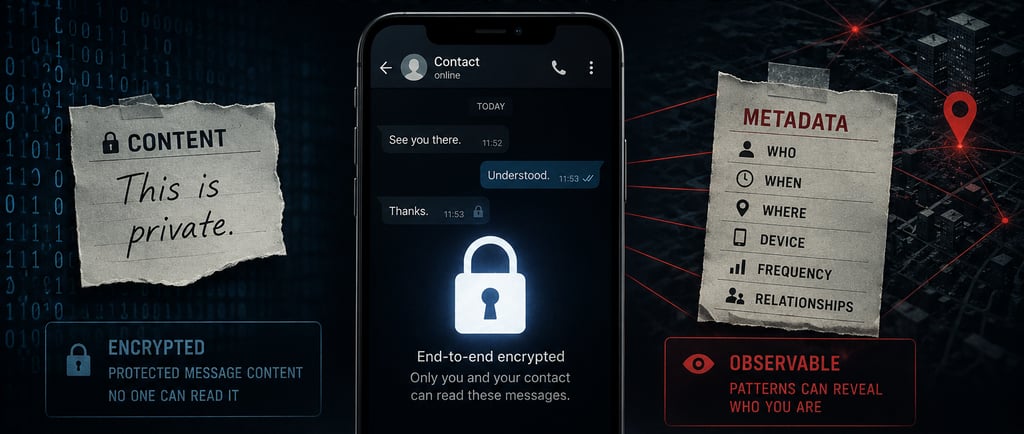
A padlock appears beside the conversation. The application confirms that the messages are end-to-end encrypted. The sender writes, presses send, and watches the message disappear into a protected channel.
It feels private.
It may even be highly secure.
But it is not necessarily anonymous.
The message may be unreadable while the identities surrounding it remain visible. The communication service may know when the account was created. The network provider may observe when the device connects. A phone number may identify the sender. A notification may reveal the recipient. A photograph may preserve the exact location where it was taken.
Encryption can conceal what was said without concealing who spoke, when they communicated, where they connected, or which devices participated.
For ordinary conversations, this distinction may appear technical. For journalists, sources, human-rights defenders, investigators, legal teams, and people operating under surveillance, it can determine whether a secure conversation truly protects the people behind it.
Understanding secure communication begins with a simple principle:
Encryption protects information. Anonymity protects identity.
They can support one another, but they are not the same protection.
What encryption actually does
Encryption transforms readable information into a protected form that should be unintelligible without the correct cryptographic key.
In end-to-end encrypted messaging, the content is encrypted on the sender’s device and decrypted on the recipient’s device. The communication provider should not possess the keys needed to read the conversation as it passes through its infrastructure.
When implemented correctly, this can protect messages against many forms of interception. A compromised network connection should not reveal the conversation in plaintext. A relay transporting the message should not be able to read it. A database containing encrypted message packages should not automatically expose their contents.
Modern messaging protocols may also provide integrity protection, sender authentication, forward secrecy, and post-compromise recovery. These properties are important because confidential communication requires more than simply making text unreadable.
The recipient must also be able to detect whether a message was altered. The system must prevent previously captured messages from being accepted again as new. The compromise of one key should not necessarily expose every message ever exchanged.
These are difficult engineering problems, and strong cryptography provides meaningful protection against them.
But cryptography operates within boundaries.
It can protect the content carried through a communication system. It does not automatically remove every trace created by that system.
The sealed envelope problem
The distinction can be understood by imagining a physical letter.
A person writes a message, places it inside an envelope, seals it, and sends it through the postal system. Someone handling the letter may be unable to read the contents without opening it.
The envelope still reveals information.
It may show the sender’s address, the recipient’s address, the postal route, the date of collection, the delivery location, and the size or weight of the package.
An observer may not know what the letter says. They may still know who sent it, who received it, where both people are located, and when the exchange occurred.
Encrypted messaging can create a similar separation.
The message content may be protected while the communication event remains observable.
This surrounding information is generally described as metadata: data that describes another piece of information rather than forming part of the content itself.
In communications, metadata can include the sender, recipient, time, location, message size, connection history, device type, account identifiers, and frequency of interaction. The Electronic Frontier Foundation warns that communications metadata can allow third parties to infer sensitive details even when they cannot access the underlying conversation.
The envelope is sealed.
The journey may still tell a story.
A conversation can be protected while a relationship is exposed
Imagine a public official contacting an investigative journalist through an encrypted messenger.
The messages may never be available to the communication provider in readable form. Yet the official’s account may be linked to a phone number. Their device may connect from a government building. The journalist may receive repeated messages immediately before publishing an investigation.
An observer does not necessarily need the message content.
The timing and relationship may be enough to identify the probable source.
This is why the social graph matters.
A social graph is the network created by communication relationships: who contacts whom, how often they communicate, which groups they join, and how separate accounts connect to one another.
For commercial platforms, this information can support advertising and behavioral profiling. For hostile investigators, it can reveal organizational structures, confidential relationships, sources, intermediaries, and communities of interest.
Signal has publicly described its efforts to minimize the service-side information available about users. Technologies such as private contact discovery, private groups, and sealed sender are intended to reduce plaintext knowledge of contacts, group relationships, profiles, and who is messaging whom.
This work illustrates an important engineering reality: encrypting the message is only the beginning.
If content encryption alone solved the entire privacy problem, metadata-minimization systems would not be necessary.
Identity often enters before the first message
An encrypted conversation may begin with an account that is already connected to a real-world identity.
Registration may require a phone number, email address, payment method, application-store account, or device-linked identifier. The service may record when the account was created, when it connected, or which network address it used.
The application can encrypt every message perfectly while the registration process identifies the person behind the account.
This does not necessarily make the service insecure. Identity-linked messaging may be appropriate for families, workplaces, public professionals, and established contacts.
It simply means the user is private, not anonymous.
This distinction becomes critical when identity exposure creates danger.
A whistleblower contacting a newsroom may need more than an encrypted channel. They may need a communication process that does not require exposing their usual telephone number, personal email address, home connection, public username, or established device identity.
That is why specialized systems such as SecureDrop exist. SecureDrop is designed for news organizations and NGOs that need to receive documents from anonymous sources, and its architecture uses Tor to reduce direct identification of the person submitting information.
A tool designed for confidential conversations and a tool designed for anonymous first contact solve related but different problems.
Using one as though it guarantees the other can create dangerous assumptions.
Your network sees a connection even when it cannot read the message
Before a message reaches an encrypted service, the device must connect to the internet.
That connection may pass through a mobile carrier, broadband provider, workplace network, public Wi-Fi system, hotel connection, or state-controlled telecommunications infrastructure.
Transport encryption may prevent these networks from reading the message content. They may still observe that the device connected to a particular service.
Depending on the system and observer, the network may expose the user’s IP address, approximate location, connection time, destination, traffic volume, and duration of activity.
This is the difference between content confidentiality and network anonymity.
Content confidentiality asks:
Can an intermediary read the message?
Network anonymity asks:
Can an observer connect this activity to the person or location producing it?
A communication system may answer the first question well and the second poorly.
Tor addresses a different layer of the problem by routing traffic through multiple relays, reducing direct linkage between the user and the online destination. A local internet provider generally sees a connection to Tor rather than the final destination, while the destination sees traffic arriving from the Tor network rather than the user’s ordinary IP address.
Onion services extend this model by allowing communication to remain inside the Tor network, providing privacy benefits to both users and service operators.
Tor does not create perfect anonymity. The Tor Project explicitly warns that perfect anonymity is generally impossible and that user behavior, configuration, downloaded files, account identity, endpoint compromise, and powerful forms of observation may still undermine protection.
The correct conclusion is not that network anonymity is ineffective.
It is that it protects a particular layer—and must be supported by the layers around it.
A familiar account can identify an anonymous connection
A person may connect through an anonymity network and then sign into an account tied to their legal name, personal telephone number, workplace address, or long-standing online identity.
The network path may be concealed.
The account identifies the user anyway.
This is a common operational mistake because people often expect the privacy tool to override everything they do inside it.
It cannot.
If a journalist uses an anonymity network and then logs into the same email account used every day from home, the provider may connect the activity through account credentials, browser characteristics, cookies, recovery details, or historical behavior.
If a source creates an anonymous profile and immediately contacts only one person they are publicly known to work with, the relationship itself may provide a clue.
If a user copies text containing personal writing patterns, shares an original document, or uploads a photograph containing identifying metadata, the protected network connection cannot remove those disclosures automatically.
Anonymity is not only a routing decision.
It is the result of every identity signal produced during an activity.
Devices create fingerprints
Even when a user avoids a direct name or telephone number, the device may reveal characteristics that help distinguish it from others.
These can include the operating system, application version, language, time zone, screen dimensions, hardware properties, network behavior, installed components, and patterns of use.
A single characteristic may identify millions of devices. A particular combination can become much more distinctive.
This process is often called fingerprinting.
Fingerprinting does not always reveal a legal identity immediately. It can allow an observer to recognize that apparently separate activities came from the same device or configuration.
This creates linkability.
A person may believe they have created two unrelated identities. If both produce a sufficiently similar technical fingerprint, an observer may infer that the same device controls them.
The distinction between anonymity and unlinkability is important here.
Anonymity attempts to conceal the real identity behind an action. Unlinkability attempts to prevent separate actions from being connected to one another.
A user may be anonymous but linkable: the observer does not know their name, but can see that the same unknown person repeatedly appears.
A user may also be identifiable but temporarily unlinkable: the observer knows who they are in one context but cannot confidently connect them to activity in another.
High-risk communications may require both protections.
The endpoint can reveal everything
Every encrypted message must become readable somewhere.
That place is the endpoint.
The endpoint may be the sender’s phone, the recipient’s laptop, a tablet, a workstation, or another authorized device connected to the account.
If an attacker controls the endpoint, the attacker may not need to defeat the encryption protocol.
They can read the message before it is encrypted or after it is decrypted.
Commercial spyware may capture screens, record keystrokes, access microphones, collect notifications, retrieve files, inspect contact records, or monitor application activity. A malicious keyboard may observe text before it enters the secure messenger. Accessibility permissions may allow another application to read interface content. A compromised operating system may expose information directly from memory.
Encryption protects the channel between devices.
It does not automatically protect the message from the device displaying it.
Physical access creates another risk. A strong communication protocol cannot compensate for a weak device passcode, an unlocked screen, an unsafe backup, or a notification showing sensitive content.
The sender may use excellent security. The recipient may leave the phone unattended on a table.
The security of the conversation is limited by the weakest participating endpoint.
Attachments can identify the sender
A photograph can be encrypted during delivery and still reveal where it was taken when the recipient opens it.
Digital files often contain information beyond the visible content.
A photograph may contain the camera model, capture time, software history, orientation, or geographic coordinates. A document may include an author name, organization, revision history, template identity, printer information, username, or internal file path.
Freedom of the Press Foundation describes file metadata as information such as timestamps, location data, and camera type that exists alongside the visible content.
Encryption can protect this information while the file is moving.
It does not necessarily remove it.
Once the recipient decrypts the attachment, the metadata becomes available with the file. If the recipient publishes or forwards it without inspection, identifying information may travel with it.
This is especially dangerous when a source believes the secure messenger has anonymized the evidence itself.
The messenger may have protected the delivery.
The document can still identify its creator.
Secure attachment handling therefore requires separate controls: metadata inspection, sanitization, safe conversion, isolation, malware analysis, and careful decisions about which version of a file should be shared.
Notifications can defeat a protected conversation
A message may arrive through an encrypted protocol and then appear in plaintext on a locked screen.
The application may be secure.
The notification becomes the leak.
A name, message preview, group title, file description, or reply prompt can expose sensitive information to anyone who sees the device.
Notification data may also become accessible to the operating system, connected wearables, desktop integrations, vehicle systems, or applications granted notification access.
The communication remains encrypted in transit, yet the surrounding ecosystem replicates part of it across multiple surfaces.
This illustrates a recurring problem in high-risk security:
Convenience expands the number of places information can appear.
Every preview, backup, synchronization feature, linked device, and recovery mechanism may introduce another party or system that must be trusted.
The safest design is rarely the design that distributes information most widely.
Cloud backups can reopen a closed door
A secure messenger may protect live conversations while an external backup preserves their contents under a different security model.
The backup may be encrypted, but important questions remain.
Who controls the keys? Can the provider recover the account? Can a reset process restore the data? Does the backup include attachments, identity information, notification history, or application state? Can another logged-in device access it? Can an attacker use account recovery to reach it?
A system that cannot read live messages may still coexist with a backup system capable of restoring them.
This is why statements such as “messages are end-to-end encrypted” must be interpreted precisely.
Which messages?
At what stage?
Under whose keys?
On which devices?
Are backups included?
What happens during recovery?
Security claims are meaningful only when their boundaries are clear.
Disappearing does not mean unrecoverable
Disappearing messages can reduce the amount of information retained inside a conversation. They are useful for limiting routine accumulation and reducing the consequences of later device access.
They do not guarantee erasure.
The recipient may capture a screenshot, photograph the display, copy the text, forward the information, preserve a notification, record the screen, or use a compromised device.
The operating system may retain temporary data. Backups may preserve earlier state. The message may have already influenced another document or investigation.
A disappearing timer controls the behavior of participating software.
It cannot control every system or person that encountered the information.
This does not make disappearing messages meaningless. Data minimization is valuable precisely because stored information creates future risk.
The limitation is that reduced retention should not be confused with guaranteed destruction.
Human behavior can connect identities that technology separated
Suppose a source uses a new device, an anonymous route, and an account containing no obvious personal information.
They communicate at the same unusual time every evening. They use phrases strongly associated with their public writing. They reference events known to only a small team. They send documents formatted with their employer’s internal template. Their activity stops whenever they travel.
No single clue proves their identity.
Together, the pattern may become revealing.
This is traffic analysis at the human level.
People create rhythms, habits, relationships, vocabulary, schedules, and mistakes. Communication systems can minimize technical metadata, but operational behavior may reconstruct identity through context.
Anonymity therefore depends partly on discipline.
The user must consider not only which tool carries the message, but what the message reveals, when it is sent, which files accompany it, which identities interact, and how the activity compares with their normal behavior.
The strongest technical system cannot prevent a user from identifying themselves inside the protected conversation.
Confidentiality and anonymity require different architectures
A confidential messenger is designed primarily to prevent unauthorized parties from reading conversations.
An anonymous submission system is designed to reduce the ability to identify the person providing information.
A censorship-resistant system is designed to remain reachable when networks attempt to block it.
A metadata-resistant system attempts to minimize relationship and activity information.
A secure device attempts to protect keys and data at the endpoint.
These systems may overlap, but they do not automatically provide one another’s guarantees.
This is why “encrypted” cannot serve as a complete description of a high-risk communication platform.
The relevant questions are broader.
Does the platform require an identity-linked account? What metadata reaches the provider? What does the network see? Can the service map relationships? Are contacts uploaded? Are backups enabled? Does communication fail closed? Can the system silently fall back to an exposed route? What happens when a contact’s identity changes? What information remains after deletion? How are attachments processed? What does recovery reveal?
Security must be evaluated as an architecture, not as a label.
Why honest language matters
Security marketing often promises privacy, anonymity, secrecy, and untraceability as though they were different names for the same product feature.
They are not.
The misuse of these words creates more than a technical misunderstanding. It can influence decisions that place people at risk.
A source who believes encryption provides anonymity may contact a journalist from an identifiable account. An activist who believes a VPN makes them untraceable may continue using a profile linked to their real identity. A legal team may assume disappearing messages eliminate records. A newsroom may recommend a secure messenger when the situation requires anonymous document submission.
The technology may work exactly as designed.
The failure occurs because the promise was misunderstood.
Credible security communication must therefore describe what a system protects, what it reveals, what it cannot control, and which assumptions must remain true.
Tor does not promise perfect anonymity. SecureDrop does not claim to eliminate every possible source risk. EFF and Freedom of the Press Foundation repeatedly emphasize threat modelling and context because no single tool can solve every exposure.
Precision is not weak marketing.
For high-risk users, precision is part of the protection.
What secure messaging should strive to reveal less of
A serious high-risk messaging architecture should protect message content while attempting to minimize the information created around it.
It should avoid collecting information that is not essential to delivery. It should minimize knowledge of contact relationships and group structures. It should separate communication identity from unnecessary public identifiers. It should protect network location where the threat model requires it. It should avoid silent fallback to weaker channels.
It should provide clear identity verification and warn users when cryptographic trust changes. It should limit notification exposure, unnecessary retention, and insecure backup paths. It should treat attachments as a separate attack surface rather than assuming encrypted delivery makes them safe.
Most importantly, it should state its limits.
No messenger can guarantee anonymity when the device is compromised. No network can conceal a user who identifies themselves through an account. No cryptographic protocol can prevent a recipient from revealing a conversation. No disappearing-message timer can erase a photograph taken by another camera.
The objective is not to create an illusion of invisibility.
It is to reduce the number of observations that can be combined against the user.
The question to ask before pressing send
Before using an encrypted messenger for sensitive communication, do not ask only whether the message can be read in transit.
Ask what else the exchange may reveal.
Does the account identify you?
Can the service observe your relationships?
Can the network see where you are connecting?
Could timing reveal why you are communicating?
Does the file contain hidden information?
Will the message appear on another screen?
Could a backup preserve it?
Is the other endpoint trustworthy?
Would the recipient recognize you through context even if the account were anonymous?
Encryption remains one of the most important protections available for digital communication. Without it, the content itself may be exposed to networks, providers, infrastructure operators, attackers, and unauthorized observers.
But encryption is not a cloak placed over the entire communication event.
It protects the message.
Anonymity requires protecting the person behind it.
For low-risk conversations, the difference may be academic.
For someone protecting a source, documenting abuse, exposing corruption, defending a client, or communicating under surveillance, it may be the difference between a secret message and a secret messenger.
Those are not the same thing.